What a Personal Brand Really Is (and Why It Matters)

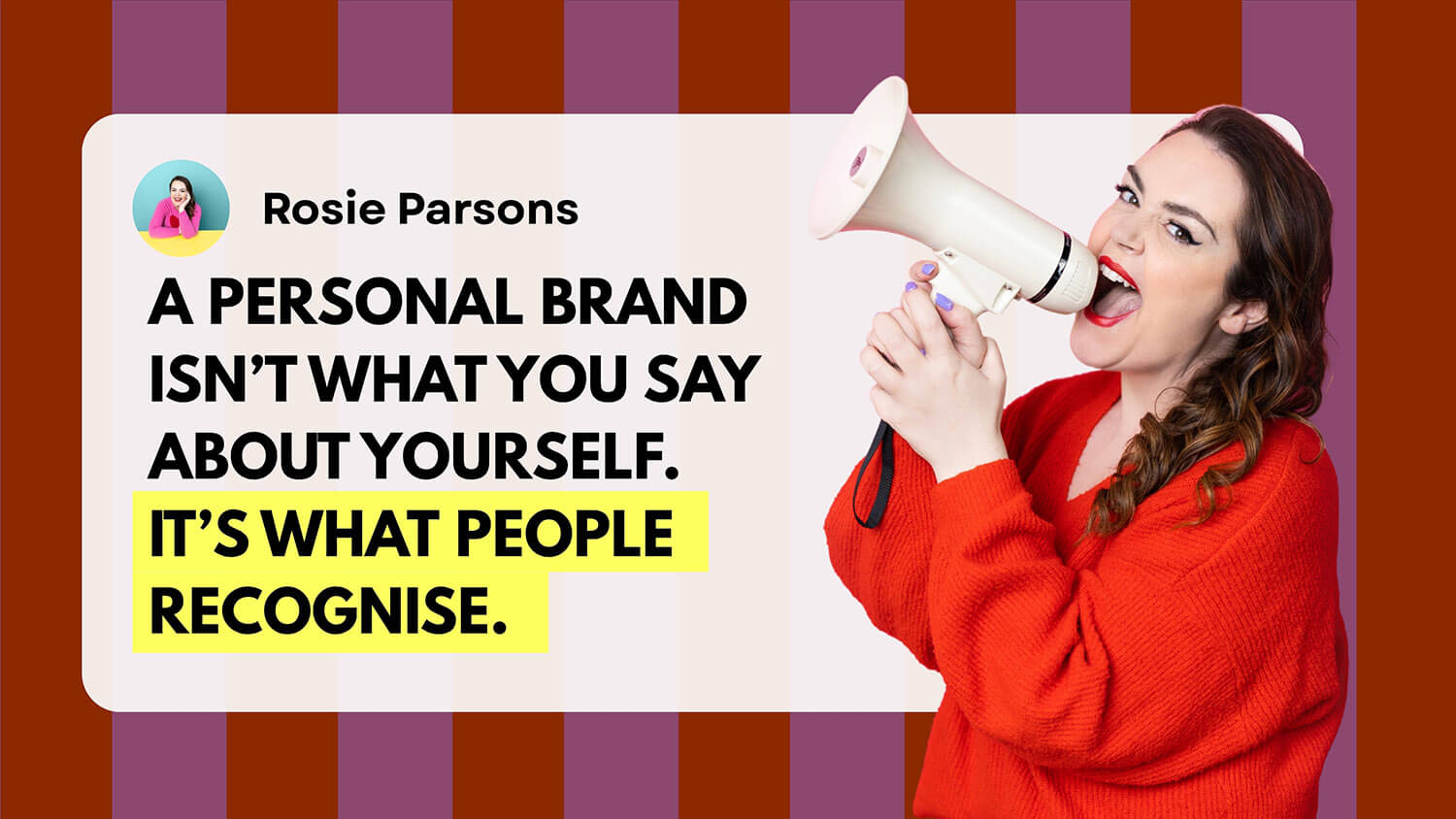
A personal brand is the public perception of an individual, shaped by how they show up, communicate, and are experienced online and offline. A personal brand is not what you say about yourself. It’s the pattern people recognise when they experience you.

Most articles will tell you a personal brand is something you build, craft, or curate (usually with a mood board and a very expensive strategist). And yes, personal branding is a process – but your personal brand? That already exists. It’s shaped by everything from your tone of voice to your visual identity to whether you’re the person who always brings homemade cake to networking events (in which case – hello and I love you).
Your personal brand identity is your public image – the impression that stays in their mind after someone visits your website, scrolls your social media profiles, or meets you at an event. It’s your true brand, whether you’ve been intentional about it or not.
In the modern world, a recognisable personal brand is a powerful tool. It helps people understand who you are, what you stand for, and whether they want to work with you – often before you’ve said a single word. (No pressure!)
This post will help you understand what a personal brand actually is, why it matters, and how to start shaping yours with intention.
You already have a personal brand (whether you work on it or not)
Here’s something that surprises most people: you don’t need to “create” a personal brand. You already have one!
Every time someone Googles you, visits your LinkedIn profile, meets you at a networking event, or hears about you from a mutual connection – they’re forming an impression. That impression is your own personal brand, and it exists whether you’ve given it a moment’s thought or not.
(Terrifying? A little bit. But also kind of freeing once you accept it.)
Your public personas are already out there. Your social circle has opinions about what you’re like to work with. Your work experience tells a story. Your personal journey – the wins, the pivots, the “what was I thinking?” moments – is already shaping how people perceive you.
The only question is: are you shaping it intentionally, or leaving it to chance?
I learned this the hard way. When I started my photography business – over 18 years ago now, I called it “Forever After Images.” I thought it sounded romantic and professional – exactly what couples would want.
I’m cringing right now just typing it.
And guess what? It attracted the most traditional brides imaginable. Lovely women, but they wanted classic white roses and string quartets, and I was over here wanting to photograph someone in a hot pink dress with a disco ball. We were not a match.
After a year or two, I gained confidence and changed the name to Rosie Parsons Photography. The kind of clients I attracted began to change as well. Same me, same skills – but a different signal, and a completely different result.
Your brand is already broadcasting something. The question is whether it’s broadcasting you – or some weird corporate version of you that you think other people want but doesn’t actually exist.
Personal brand vs personal branding (what people get wrong)
These two terms get used interchangeably, but they’re not the same thing!
Personal brand = the outcome. It’s how people perceive you. It’s the impression you leave, the associations people make, and the reputation you carry – online and offline.
Personal branding = the process. It’s the intentional work of shaping that perception through your messaging, visuals, content, and behaviour.
Think of it this way: your personal brand is what people say about you when you’re not in the room. Personal branding is what you do to influence that conversation. (Preferably so they’re saying nice things and not “oh, she’s the one with the really confusing website.”)
This distinction matters because too many people focus on tactics – a personal brand statement here, a personal branding statement there – without first understanding what they’re actually trying to shape. A corporate brand has the same challenge: the logo and tagline mean nothing if the underlying perception doesn’t match.
In any professional community or corporate setting, the people who stand out aren’t the ones with the slickest marketing. They’re the ones whose professional brands feel consistent and real – where the promise matches the experience.
Why so many brilliant women feel unseen
If you’ve ever thought, “I don’t even know what my brand is” – you’re not alone. Most people feel the same way.
This is one of the most common frustrations I hear from business owners. But the feeling of being “all over the place” isn’t a competence problem. It’s a clarity problem.
Most capable women I work with have plenty of skills, experience, and value to offer. But they haven’t decided what they want to be known for – so they end up showing a little bit of everything, and none of it sticks.
In a world where everyone is shouting for attention, your potential clients can’t remember you if you haven’t given them something specific to remember. And your target audience can’t connect with you if you’re trying to appeal to everyone. You don’t build a competitive advantage if you’re blending in with the crowd. But that doesn’t need to feel stressful – it is actually liberating!
I spent a year photographing corporate clients in boardrooms against white backgrounds. The work paid, but I didn’t feel creatively fulfilled – and I didn’t even get to know anyone I was photographing. I’d turn up, take photos of people looking vaguely uncomfortable in suits, and leave. It was disheartening, honestly. I was doing “professional” work, but it wasn’t me.
Once I got clear on my specific audience – female entrepreneurs who wanted bold, colourful brand photography – everything changed. Not just my bookings, but how much I actually enjoyed getting out of bed in the morning!
Clarity isn’t limiting. It’s freedom and being able to live your passion!
You don’t have to be “unique” to stand out
Differentiation comes from being recognisable, not from trying to be different.
Most advice about standing out goes something like this: find your unique value proposition, identify your unique perspective, develop a unique approach.
Cue everyone staring at a blank page trying to figure out what makes them different from the 47,000 other people who do the same thing.
The pressure to be “unique” is exhausting. But the good news? It’s a bit misguided.
Here’s what I’ve learned after 18 years working for myself: differentiation doesn’t come from being the most original. It comes from being the most recognisable.
You don’t need to be the best in your field to be chosen. You don’t need some revolutionary angle that nobody’s ever thought of. You just need to show up consistently as yourself – and let the right people find you.
Think about how we choose friends. We’re not ranking them on innovation or market positioning! We’re drawn to people whose energy we like, whose values we share, whose vibe feels right.
Business works the same way.
The most powerful personal brands aren’t trying to be unique. They’re trying to be unmistakably themselves.
What happened when I stopped playing it safe
After having children I had started getting most of my photography work via business networking. But during lockdown, all my in person referral work dried up overnight. I was sitting at home with four kids climbing the walls, thinking, “Well, this is fun.”
But I also had nothing to lose. So I thought about if I wasn’t going to get paid, what would I most want to spend my day photographing? And that prompted me to contact women I admired, create the colourful portfolio I’d always wanted, and start posting bold, playful images that felt like me.
People loved it. Bookings skyrocketed! Not because I’d invented something new – but because I’d finally committed to being recognisable and enjoying myself doing the work I most wanted to do.
“What you show is what you attract.”
Your competitive edge isn’t some clever differentiator buried in a strategy doc. It’s your true self, expressed consistently enough that people start to recognise you.
You don’t need to be a thought leader. You just need to be you – repeatedly, visibly, and without apology.After having children I had started getting most of my photography work via business networking. But during lockdown, all my in person referral work dried up overnight. I was sitting at home with four kids climbing the walls, thinking, “Well, this is fun.”
But I also had nothing to lose. So I thought about if I wasn’t going to get paid, what would I most want to spend my day photographing? And that prompted me to contact women I admired, create the colourful portfolio I’d always wanted, and start posting bold, playful images that felt like me.
People loved it. Bookings skyrocketed! Not because I’d invented something new – but because I’d finally committed to being recognisable and enjoying myself doing the work I most wanted to do.
“What you show is what you attract.”
Your competitive edge isn’t some clever differentiator buried in a strategy doc. It’s your true self, expressed consistently enough that people start to recognise you.
You don’t need to be a thought leader. You just need to be you – repeatedly, visibly, and without apology.
Personal brands are built through patterns, not moments
A personal brand is built through repeated signals over time, not one-off moments of visibility.
A strong personal brand isn’t built in a single viral post or one brilliant photoshoot. (I know. I wish it worked that way too.)
It’s built through repetition.
Recognition comes from consistency. The key elements of an effective personal brand – your visuals, your voice, your values – need to show up again and again before they stick. It’s like that song you hated the first time you heard it, and now you can’t stop singing in the shower.
This takes a lot of time. There’s no shortcut, sorry! But the compound effect is real: every post, every photo, every interaction adds to your body of work and deepens the lasting impression you leave.
I’ve seen this play out in my own business (the hard way, obviously, because that’s how I learn everything).
When I had an assistant handling my social media – filming behind-the-scenes content, posting consistently – my enquiries were constant. Then she moved on, and I thought, “Do I really need to replace her? How important can it be?”
Spoiler alert: it was important.
I didn’t replace her. And my enquiries disappeared faster than high quality cookies at a networking event.
If people can’t see you, they’re not being reminded of you. And if they’re not being reminded of you, they’re not reaching out.
Once I started showing up again – making a plan, being visible, staying consistent – it all came back. The pattern matters more than any single moment. I even started getting spotted by people who had seen me online when I was out and about in public – disconcerting but fun! Just had to remember not to speak crossly at the children in the vicinity of anyone who could be a potential linkedin connection, haha!
The core elements of your brand need to become familiar. That’s how trust is built.
Your face is part of your personal brand (and why that matters)
In service-based businesses, people don’t just buy what you do. They buy you.
Your face helps people build trust before they’ve ever spoken to you. It creates familiarity. It makes your online presence feel human rather than corporate. Nobody wants to hire a logo.
This is why your social media presence matters – not as a vanity metric, but as a connection point. When someone sees your face across different platforms, on your personal website, in your social media accounts, they start to feel like they know you.
That feeling? It’s powerful. And slightly bizarre. But mostly powerful.
I now have clients who fly in from abroad for photoshoots. Actual plane journeys! When I ask why they chose me, the answer is almost always some version of: “I feel like I already know you.” They’ve been following my content for years. By the time they book, it feels like we’re two friends already. Yay!
That doesn’t happen through faceless content. It happens when you show up – really show up – and let people see you.
One of my most popular pieces of content ever was a simple “about me” video. Just me, showing my everyday life, the normal stuff. Making a cup of tea. Sharing my favourite things to do and places I go. Nothing fancy.
It got 150,000 views.
Your face is a communication channel. Use it! And if you’re not sure where to start, here’s how to take a good selfie that actually looks like you.
Want professional-looking photos without the professional price tag? Learn how to take scroll-stopping DIY brand photos with your phone in Slay Your Selfies!
Being yourself will repel some people – and that’s a good thing!
This is the part that scares most people. If I’m really myself, won’t I put some people off?
Yes. That’s the point!
Your personal brand is a filter. It attracts the right people and repels the wrong ones – which saves everyone time. Think of it as a public service, really.
Would you rather spend an hour in a room with 200 people (half of whom make you want to fake an emergency phone call and hide in the toilets), or 10 like-minded people who make you feel happy, positive and excited about life? I know which I’d rather!
When you show up authentically, some potential clients will think, “Oh, that’s not for me.” Good! They weren’t your people anyway. The ones who do resonate with you will connect faster, trust you sooner, and be far more enjoyable to work with.
That’s a positive experience for everyone – and a positive impact on your business success.
Here’s something I haven’t shared before. For years, I held back online because I was trying to date – and in the back of my mind I was worried about how I’d come across if someone I liked Googled me. If I was too honest about my weight struggles, or “too much” would some future boyfriend see my Instagram and run away?
A few years ago, I decided to stop dating and just focus on my kids and business. And that decision has been a surprising liberation for me that I didn’t see coming.
I stopped filtering myself for an audience I wasn’t even trying to reach. Now I only care about attracting people who like me for me. My clients aren’t bothered about how much I weigh. They want to feel understood, helped, and get great results.
When you stop performing for the wrong audience, you finally have space to connect with the right one. I wrote more about this for Entrepreneur if you want to dig deeper.
Practical ways to build your personal brand (beyond photos)
You don’t need a complete rebrand or a five-figure photoshoot to start building your personal brand. While those are great as you get more successful, you can start building your brand whatever stage you’re at. Small, consistent actions work better than one big gesture. (And they’re much cheaper.)
Here’s some practical advice for your first step:
Start with who you’re drawn to. If you’re not sure what you want to be known for, look at the people you admire. Are you drawn to brand photographers who feel warm and friendly? Or someone more classic and elegant? Do you like content that feels authoritative and polished, or playful and approachable?
The suppliers, creators, and brands you gravitate toward are clues to your own brand identity. Start there! It’s basically just shopping research, which most of us are already excellent at.
Commit to your choices. This is the most common mistake I see: not fully committing to the brand you’ve chosen.
You can have many facets to your personality – of course you can! But if you want to be known for a particular feeling or style, you need to protect that signal.
I’m known for colour and playfulness. That doesn’t mean I never wear black – I’m not a monster. But I wouldn’t show up to a networking event in head-to-toe black, and I wouldn’t share photos where I’m dressed in muted tones. That would be confusing for people. Every touchpoint should tell the same story.
Create valuable content around what you want to be known for. Active engagement builds familiarity. Talk about your topics, share your perspective, and let people get to know your voice.
The next step doesn’t need to be complicated. It just needs to be consistent.
The core elements of a strong personal brand
When you break it down, every strong personal brand has a few core elements working together:
Visual identity and visual consistency. This includes your colour scheme, what you wear in your photos, and the overall aesthetic of your online presence. People should be able to recognise your content before they see your name.
Tone of voice. How do you sound? Warm and conversational? Direct and no-nonsense? Your voice should feel consistent across your website, social media, and real-life interactions.
Core values and guiding principles. What do you stand for? What matters to you? These don’t need to be grand statements carved into marble – but they should come through in everything you do.
Personal goals and professional goals. Where are you heading? What are you building? A clear sense of direction helps people understand how you might fit into their world.
A useful exercise: choose five words you want people to associate with your brand. Then check everything you put out against those words. Does it reinforce them – or contradict them?
My five words are colourful, playful, warm, confident, and approachable. Every piece of content, every outfit choice, every client experience gets filtered through that lens. It’s like having a really helpful checklist for every decision.
Choose where to show up (you don’t need to be everywhere)
One of the biggest traps in building a social media presence is trying to be on every platform at once.
Spoiler: you will burn out. You will hate it. You will start resenting your phone.
You don’t need a YouTube channel, TikTok, a podcast, and a newsletter. You need to show up consistently on the social media platforms where your people actually are.
For many business owners, that might be LinkedIn and Instagram. For others, it might be a personal website and an email list. There’s no universal answer – only the answer that works for your audience and your energy.
Pick one or two different platforms. Get good at those. Let the others wait. They’ll still be there when you’re ready.
How photos help people understand you faster
Photos aren’t about vanity. They’re about translation.
Your visual identity communicates things that words can’t – your energy, your style, your vibe. A great photo helps someone understand you in seconds, before they’ve read a single line of copy. It’s like a cheat code for connection.
This is why visual consistency matters. When your photos match your brand, people get a coherent sense of who you are. When they don’t, it creates confusion – and confusion kills connection.
I’ve photographed hundreds of women who arrived at my studio feeling incredibly awkward in front of the camera. Most of them came to me convinced they weren’t photogenic! They’d apologise before we even started. “Sorry, I’m terrible at this. My face does weird things in photos.”
By the end of the shoot, they’ve relaxed, had fun, and walked away with images that actually look like them – just the most confident, polished version.
The best personal branding examples aren’t the most glamorous. They’re the ones where the person’s personality comes through clearly, and the visuals match the message.That’s a great example of what brand photography is really for: not making you look “perfect,” but making you look like you. Just… really good you.
Frequently asked questions about personal brands
The key elements of a personal brand include your visual identity, tone of voice, core values, and the way you consistently show up. Together, these create recognition and trust over time. A strong personal brand feels coherent, human, and easy to understand.
A personal brand is important because it helps people quickly understand who you are, what you stand for, and whether they trust you. In a crowded digital world, clarity builds recognition, and recognition creates opportunity.
Yes – especially if you want to grow! Potential employers and business leaders increasingly look at candidates’ online presence before making decisions. A clear personal brand helps you stand out and opens doors to new opportunities. (Even if you love your job, it never hurts to have options.)
Not at all. Personal branding matters for anyone who wants to be known for their work – whether you’re a freelancer, a founder, a keynote speaker, or an employee looking to land your dream job. If people need to trust you before working with you, your brand matters.
There’s no fixed timeline, but expect months rather than weeks. (Sorry, I know that’s not what you wanted to hear.) A strong personal brand is a body of work built over time through consistent visibility. The goal isn’t speed – it’s becoming a reliable reference point in your field.
Absolutely! Personal branding isn’t about sharing everything. It’s about being intentional with what you do share. You control the boundaries. The goal is reaching new audiences with a consistent message – not exposing your entire life. Keep the mystery. It’s fine.
What’s next?
If you’ve made it this far, you already understand something important: your personal brand exists whether you tend to it or not.
The only question is whether you’ll shape it with intention.
You don’t need to have it all figured out. You don’t need to be the “best version” of yourself before you start. Personal growth happens through the process, not before it. (If we all waited until we were ready, nobody would ever do anything.)
The life lessons I’ve learned about branding came from doing it imperfectly, learning as I went, and gradually becoming more myself in public. It’s been messy. It’s been awkward. There have been questionable outfit choices. But it’s worked.
Your next step doesn’t need to be dramatic. It might be as simple as choosing your five brand words. Or updating your profile photo. Or posting something that actually sounds like you.
Start where you are. Be consistent. And trust that the right people will find you.
Ready to show up with confidence?
If you want to create professional-looking brand photos that capture your personality – without needing to hire a photographer – Slay Your Selfies will teach you how to do it with just your phone.
Get visible, get confident, and let’s get you booked!